
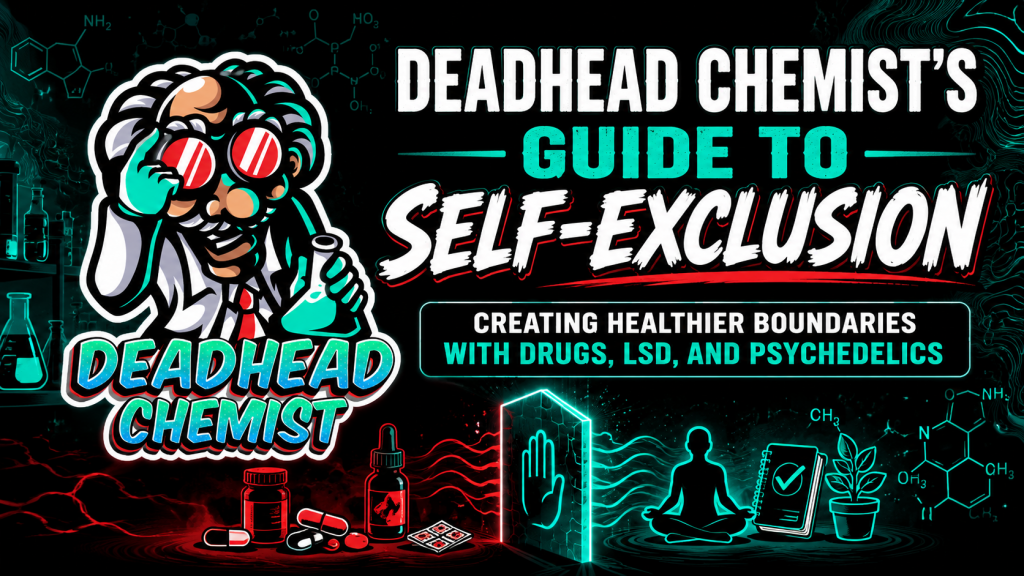
Self-exclusion is commonly associated with gambling platforms and other high-risk activities, but the same idea can also help people who want to take a break from drugs, LSD, psychedelics, party substances, or environments where substance use feels difficult to avoid.
Drug self-exclusion is not about embarrassment, punishment, or judgment. It is about intentionally creating distance between yourself and the people, places, websites, routines, and emotional triggers that make substance use more likely.
For many people, deciding to stop is only the first step. The real challenge is creating a lifestyle and environment that make the decision easier to maintain.
This Deadhead Chemist guide explains what drug self-exclusion means, how to establish practical boundaries, who can support you, and when excluding LSD or other psychedelics may be worth considering. It also covers relapse prevention, social planning, mental-health considerations, and healthier ways to replace substance-related routines.
Important: This article is intended for general educational and harm-reduction purposes. It is not medical advice. Withdrawal from alcohol, benzodiazepines, opioids, or certain other substances can be dangerous. Speak with a qualified healthcare professional before stopping regular or heavy use suddenly.
What Does Drug Self-Exclusion Mean?
Drug self-exclusion is the intentional process of reducing access to substances and creating practical barriers between yourself and drug use.
A self-exclusion period may be temporary, long-term, or permanent. Some people begin after a frightening experience, while others are concerned about their mental health, relationships, finances, work performance, sleep, or emotional stability.
Drug self-exclusion may involve:
- Deleting contacts connected to obtaining substances
- Leaving drug-related group chats
- Blocking websites, apps, or social accounts
- Removing substances and paraphernalia from your home
- Avoiding parties or venues connected to previous use
- Asking friends not to offer you substances
- Creating a substance-free living environment
- Attending counseling or peer-support meetings
- Taking a temporary break from LSD or psychedelics
- Developing new routines for weekends and social events
The goal is not simply to say, “I will not use.”
The goal is to build an environment where accessing substances becomes more difficult and making healthier decisions becomes easier.
Why Self-Exclusion Can Work Better Than Willpower
Willpower can change depending on your mood, surroundings, stress level, sleep, social pressure, and access to substances.
You may feel completely committed in the morning but experience intense cravings after an argument, a stressful workday, a party invitation, or a late-night message from an old contact.
Self-exclusion creates structure before those difficult moments happen.
A strong plan can:
- Make substances less immediately accessible
- Create time between a craving and a decision
- Reduce exposure to triggering people or environments
- Increase accountability
- Protect you during moments of low motivation
- Replace old routines with healthier alternatives
- Make your goals clear to supportive friends and family
“I am going to avoid drugs” is a reasonable starting point.
However, a more effective plan may be:
“For the next 90 days, I will delete my old contacts, avoid two specific venues, leave drug-related group chats, tell my closest friend about my decision, and attend one support meeting each week.”
Specific boundaries are easier to follow than vague intentions.
How to Self-Exclude From Drugs
1. Identify What You Are Excluding
Be clear about the substance or behavior you want to change.
Are you excluding:
- All recreational drugs?
- LSD or other psychedelics?
- Cocaine or stimulants?
- MDMA or party drugs?
- Ketamine?
- Cannabis?
- Prescription pills used without medical supervision?
- Mixing multiple substances?
- Drug-centered parties and after-hours events?
Different substances are connected to different triggers.
LSD exclusion may involve avoiding psychedelic-focused gatherings, online communities, playlists, or social groups. Stimulant exclusion may require stepping away from nightlife or alcohol-heavy environments. Cannabis exclusion may involve rebuilding your evening, sleep, and relaxation routines.
Specificity allows you to create a plan that addresses your actual risks.
2. Remove Easy Access
Access can turn a temporary craving into an immediate decision.
Delete contacts associated with obtaining substances. Leave chats where use is encouraged. Block websites or delivery channels. Remove paraphernalia and leftover substances from your home.
You may also need to unfollow accounts that romanticize drug use or repeatedly expose you to triggering content.
This is not an overreaction. It is a practical way to make your decision visible within your environment.
3. Tell Someone You Trust
Self-exclusion is easier when at least one safe person knows what you are doing.
Choose someone who will respect your boundaries rather than pressure, mock, or expose you.
You can keep the conversation simple:
“I am taking a break from drugs, and I need you not to offer me anything or invite me to events where using is the main activity.”
A trusted friend can help you leave a risky situation, check in during cravings, or remind you why you started.
When personal support is unavailable, consider speaking with a doctor, therapist, addiction counselor, peer-support worker, sponsor, or local helpline.
4. Create a Trigger Map
Write down the situations that make substance use more likely.
Triggers may include:
- Certain friends or social groups
- Payday
- Nightclubs or festivals
- Alcohol use
- Boredom
- Dating situations
- Stress or burnout
- Arguments
- Loneliness
- Insomnia
- Anxiety
- Trauma memories
- Feeling left out
- The belief that everyone else is having more fun
A trigger map is not a record of failure. It is a practical guide showing where additional protection may be needed.
Once you recognize your patterns, you can prepare for them.
5. Build a Substance-Free Support Kit
Create a small kit that supports you during nights out, parties, festivals, travel, or difficult moments.
Useful items may include:
- Electrolyte or hydration packets
- Gum, mints, or sour candy
- A grounding object or fidget tool
- Earplugs
- A portable phone charger
- A note listing your reasons for taking a break
- Ride-share credit or transit money
- Contact information for supportive people
- A small journal
- Non-alcoholic drinks
- Breathing or grounding prompts
These items will not eliminate cravings by themselves. However, they can give your body, attention, and nervous system something healthier to focus on.
6. Plan Your Exit Before Arriving
Before attending a party, concert, festival, or social gathering, decide how you will leave if the environment becomes uncomfortable.
Arrange your own transportation whenever possible. Tell a trusted person that you may leave early. Keep enough money or phone battery available to book a ride.
Avoid depending entirely on someone who may pressure you to stay.
An exit plan is most useful when it is created before your confidence begins to weaken.
7. Replace the Reward
Self-exclusion becomes more difficult when it feels like every source of pleasure has been removed.
Create new rewards and routines.
After a substance-free event, consider planning:
- A favorite meal
- A movie
- A gym class
- A massage
- A relaxing morning
- A new book or hobby
- A hike
- A creative project
- Time with supportive friends
Your brain needs evidence that self-exclusion is not only about losing something.
It can also mean better sleep, improved focus, more money, fewer regrets, stronger relationships, emotional stability, and greater self-respect.
Managing Social Pressure
For many people, the strongest trigger is not the substance itself. It is the desire to belong.
You may worry that declining will make you appear boring, judgmental, uncomfortable, or disconnected.
Prepare a few simple responses in advance:
- “I am taking a break.”
- “I am doing a reset.”
- “I am staying clear tonight.”
- “I have an early morning.”
- “I am focusing on my mental health.”
- “No thanks, I am good.”
You do not owe anyone a detailed explanation.
People who genuinely support you will respect your boundary. Someone who continues pressuring you after you decline is giving you important information about whether they belong in your support system.
Who Can Support Your Self-Exclusion Journey?
Healthcare Professionals
A doctor, psychiatrist, nurse practitioner, or addiction medicine specialist can evaluate withdrawal risks, mental-health symptoms, medication interactions, and treatment options.
Medical support is especially important when alcohol, benzodiazepines, opioids, or multiple substances are involved.
Therapists and Counselors
Therapy can help address the emotional reasons behind substance use, including anxiety, depression, trauma, ADHD, social fear, grief, loneliness, and burnout.
Cognitive behavioural therapy, motivational interviewing, trauma-informed care, and relapse-prevention counseling may all be helpful.
Peer-Support Communities
Peer groups can reduce isolation and provide practical strategies from people with similar experiences.
Options may include Narcotics Anonymous, SMART Recovery, Recovery Dharma, LifeRing, local recovery programs, and sober community groups.
Different programs use different approaches, so it may take time to find one that feels appropriate.
Trusted Friends and Family
A supportive friend or relative can help you avoid risky events, leave uncomfortable situations, celebrate milestones, and remain accountable.
Choose people who respect your boundaries and do not romanticize your previous patterns.
LSD Self-Exclusion
LSD self-exclusion means intentionally avoiding LSD along with the people, environments, sources, content, and rituals associated with using it.
Someone may consider LSD exclusion after experiencing:
- Panic or paranoia
- Derealization or dissociation
- Worsening anxiety
- Risky behaviour
- Lingering visual or perceptual changes
- Pressure to increase the dose
- Frequent or compulsive use
- Negative effects on relationships or work
- Mixing LSD with other substances
- Using LSD as the primary way to manage emotions
Some people describe psychedelic experiences as meaningful, creative, or personally valuable. However, psychedelics are not risk-free, and their effects can be unpredictable.
They can intensify emotions, significantly change perception, and worsen distress in vulnerable situations.
People with a personal or family history of psychosis, bipolar disorder, severe anxiety, or certain medical conditions may face additional risks. Psychedelics may also interact with medications and may be illegal depending on your location.
Taking a break does not erase meaningful experiences you may have had. It gives you space to evaluate whether continued use is currently helping or harming your life.
What If Psychedelics Feel Helpful?
Researchers continue to study psychedelic-assisted therapy for depression, anxiety, PTSD, and substance-use disorders.
However, supervised clinical treatment is very different from unsupervised use.
Clinical programs generally involve:
- Medical and psychological screening
- Preparation sessions
- Controlled dosing
- Trained supervision
- A structured environment
- Integration therapy
- Follow-up care
Using LSD or mushrooms alone, at a party, or without professional support does not provide the same safeguards.
Consider asking yourself:
- Am I using within a legitimate and legal clinical program?
- Do I have a diagnosis or structured treatment plan?
- Am I receiving integration or counseling support?
- Are the benefits lasting?
- Do I feel that I need to keep using to feel okay?
- Am I increasing the dose or frequency?
- Am I experiencing anxiety, dissociation, insomnia, or mood changes?
- Am I avoiding other forms of mental-health care?
A temporary exclusion period may be helpful when psychedelic use is escalating, unsupervised, emotionally destabilizing, or becoming your only coping strategy.
People participating in a legitimate clinical program should discuss changes with their treatment provider rather than abruptly abandoning care.
Signs Your Self-Exclusion Plan Is Working
Progress may appear gradually.
You may notice:
- Fewer or shorter cravings
- Improved sleep
- More money saved
- Less contact with risky people
- Better emotional control
- Increased confidence saying no
- Greater interest in hobbies or fitness
- Fewer regrets after weekends
- More consistency at work
- Improved relationships
- Reduced shame
- Increased trust in yourself
Cravings do not mean your plan is failing. They are experiences that can pass without becoming actions.
What to Do After a Relapse
Using again after beginning self-exclusion does not erase all previous progress.
Pause and examine what happened:
- Was access too easy?
- Were you around unsafe people?
- Did you drink alcohol first?
- Did you attend an event that was too risky?
- Were you stressed, tired, hungry, lonely, or overwhelmed?
- Did you lack transportation or an exit plan?
- Did you keep your struggle private when you needed support?
Use the experience to strengthen your plan.
You might delete another contact, avoid a specific venue, tell an additional person, attend a meeting, arrange counseling, or change how you spend weekends.
Seek urgent assistance when a relapse involves overdose risk, dangerous substance combinations, blackouts, severe mental-health symptoms, or thoughts of self-harm.
Building a Substance-Free Social Life
Trying to maintain the exact same social life while removing only the substances may not always work.
Consider building routines where substance-free participation feels normal.
Options may include:
- Fitness groups
- Hiking
- Creative workshops
- Board-game nights
- Sports leagues
- Volunteering
- Coffee meetups
- Film clubs
- Morning events
- Alcohol-free venues
- Sober music events
- Wellness gatherings
- Beach or park meetups
A substance-free gathering can still include music, lighting, games, food, drinks, photography, conversation, and celebration.
People do not only want intoxication. They also want connection, excitement, belonging, creativity, confidence, and memorable experiences. Those needs can be met in healthier ways.
Deadhead Chemist Community Offer
Explore eligible Deadhead Chemist merchandise, educational resources, and legally permitted products while the current promotion is available.
Get 50% off with promo code FB50.
Offer availability, exclusions, and legal purchasing requirements may vary by product and location.
Final Thoughts
Self-exclusion is not a sign of weakness. It is an act of awareness and self-respect.
It means recognizing that access, environment, habits, emotions, and social pressure can shape your decisions. It means creating protection before a difficult moment turns into a crisis.
Whether your goal is complete drug exclusion, LSD exclusion, psychedelic exclusion, or a temporary reset, begin with practical structure:
Remove easy access. Tell someone safe. Identify your triggers. Create an exit plan. Replace old routines. Build a support system. Seek professional care when needed.
The process does not need to be perfect to be meaningful.
Self-exclusion does not have to be the end of your social life. It may become the beginning of a healthier and more intentional one.